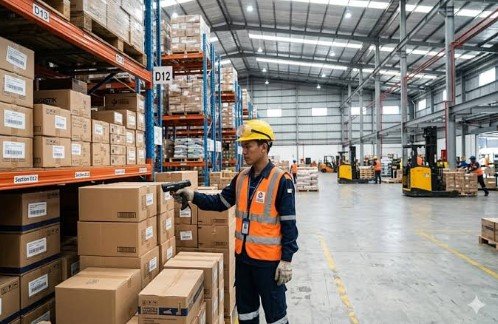
Warehouse Capacity to Fulfilment Intelligence
Saudi Arabia’s logistics transformation is creating opportunities across almost every part of the supply chain. New logistics infrastructure, expanding ecommerce activity, growing domestic consumption, and the Kingdom’s ambition to become a global logistics hub are encouraging businesses to rethink how they move and manage products.
But infrastructure is only one part of the equation.
A larger warehouse does not automatically create a more efficient supply chain. More inventory does not necessarily mean better product availability. And processing orders faster does not always mean fulfilling them more profitably.
The next competitive advantage will increasingly come from the quality of decisions made between the moment inventory enters the network and the moment a product reaches the customer.
That means Saudi businesses need to think beyond individual warehouses and individual orders.
They need to understand how the two interact.
An order creates a demand for inventory. That demand affects warehouse workload. Warehouse capacity influences fulfilment decisions. Inventory availability determines which orders can be fulfilled. The resulting operational data should then influence future decisions.
When these activities operate independently, businesses accumulate friction.
When they operate as one connected system, the supply chain becomes significantly more responsive.
Saudi Arabia’s Logistics Opportunity Is Becoming More Sophisticated
Saudi Arabia has made logistics a central component of its economic transformation.
The National Transport and Logistics Strategy aims to strengthen the Kingdom’s position as a global logistics hub and improve connectivity between Asia, Europe, and Africa. The country’s logistics development is therefore about much more than supporting domestic commerce.
It is creating the foundations for a broader regional role.
For businesses, this means the potential operating environment is becoming considerably larger.
A company may serve customers across Riyadh, Jeddah, Dammam, and other domestic markets while also using Saudi Arabia as a base for regional distribution.
That creates a different set of operational requirements.
Inventory can no longer be managed purely according to local demand.
Warehouses cannot be planned independently from customer orders.
Fulfilment decisions cannot rely on static assumptions.
As the network grows, the number of possible operational decisions grows with it.
The Problem With Optimising the Warehouse in Isolation
Warehouse managers are naturally focused on making their facilities efficient.
They want to increase picking productivity.
Reduce travel time.
Improve storage utilisation.
Accelerate receiving.
Reduce errors.
These are all legitimate objectives.
But there is a risk in optimising the warehouse independently.
A warehouse can become extremely efficient at processing orders that should never have been routed there in the first place.
For example, consider a business operating three fulfilment facilities.
Warehouse A has the lowest processing cost but is already handling a significant volume of orders.
Warehouse B has slightly higher operating costs but substantial available capacity.
Warehouse C is closest to a particular customer segment but has limited inventory.
If every order is automatically routed based on proximity or historical rules, the business may unintentionally overload one facility while leaving another underutilised.
The warehouse teams may still achieve excellent productivity metrics.
The network, however, remains inefficient.
This is why warehouse performance needs to be considered alongside order allocation.
The Order Should Be Treated as a Network Decision
An order is more than a transaction.
It is a request for the business to deploy inventory, labour, warehouse capacity, transportation resources, and customer service commitments.
Every order therefore creates a network decision.
The business needs to determine:
- Where the inventory should come from
- Which facility should process it
- Whether the complete order can be fulfilled from one location
- Whether splitting the order is justified
- Which delivery option should be used
- Whether the selected warehouse has sufficient capacity
- How fulfilling the order affects future inventory availability
The simplest decision is not always the best decision.
The nearest warehouse may not be the most economical.
The warehouse with inventory may not have the capacity to fulfil the order efficiently.
The cheapest option may not meet the customer’s delivery commitment.
A mature operation evaluates these factors together.
Why Real-Time Warehouse Information Matters
None of these decisions can be made reliably without accurate operational information.
A business needs to know what inventory actually exists.
But it also needs to know where it exists, whether it is available, whether it is allocated, and whether it can be picked and shipped within the required timeframe.
This is where WMS Software in Saudi Arabia can play an important role.
Modern warehouse management systems provide visibility across receiving, put-away, storage, replenishment, picking, packing, and dispatch. They can help businesses maintain more accurate inventory records while giving warehouse teams greater visibility into operational workloads and priorities.
The strategic value extends beyond the warehouse itself.
Accurate warehouse information gives the wider organisation a more reliable understanding of what can actually be fulfilled.
That distinction is crucial.
A product existing somewhere in the network does not necessarily mean it is available for a specific customer.
From Inventory Visibility to Inventory Confidence
There is an important difference between knowing how much inventory the business owns and knowing how much inventory the business can confidently promise.
Suppose a retailer has 1,000 units of a product.
Two hundred are allocated to existing customer orders.
One hundred are being transferred between warehouses.
Fifty are undergoing quality checks.
Another 100 are reserved for a major retail customer.
The business technically owns 1,000 units.
But the immediately available quantity is much smaller.
If sales channels display the full quantity as available, the business risks overselling.
If order allocation systems do not understand these distinctions, warehouse teams eventually become responsible for resolving the resulting problems.
This is why inventory accuracy should be considered a commercial capability, not simply a warehouse KPI.
The Saudi Ecommerce Opportunity Makes Coordination More Important
Saudi consumers have become increasingly comfortable with digital commerce, while businesses continue expanding their presence across ecommerce platforms and direct-to-consumer channels.
This creates a broader operational challenge.
The same inventory may be exposed through multiple channels at the same time.
A customer could purchase through a brand website while another customer purchases the same SKU through a marketplace.
A promotional campaign can create a sudden increase in demand.
A physical retail store may also require replenishment from the same inventory pool.
Without coordinated order management, these channels can compete for inventory without understanding the wider consequences.
The result may be overselling in one channel, excess stock in another, or unnecessary transfers between facilities.
Why Order Management Should Sit Above Channel Complexity
Businesses should not have to create a separate fulfilment strategy for every sales channel.
The underlying inventory and fulfilment logic should remain connected regardless of where an order originates.
This is where Order Management Saudi Arabia becomes strategically relevant.
A modern order management platform can provide a central layer for consolidating orders from multiple channels, determining inventory availability, applying fulfilment rules, and directing orders toward appropriate locations.
Instead of asking warehouse teams to manually determine how every order should be fulfilled, the organisation can establish consistent rules around factors such as location, inventory, capacity, delivery commitments, and cost.
This turns order management into an orchestration capability rather than simply an order-processing function.
Build Fulfilment Rules Around Business Priorities
Saudi businesses can improve their operations by creating a clear hierarchy for fulfilment decisions.
Start with the customer commitment
The first question should always be whether the selected fulfilment route can meet the promised delivery or collection timeframe.
A lower-cost option is not valuable if it causes the business to miss its commitment.
Check genuine inventory availability
The system should distinguish between physical stock, allocated stock, reserved stock, damaged inventory, and fulfilable inventory.
Evaluate warehouse capacity
A location with available inventory may still be operationally unsuitable if its picking, packing, or dispatch workload is already too high.
Consider fulfilment economics
Compare transportation and handling costs across feasible fulfilment locations.
Assess the impact on the wider network
A decision that solves today’s order may create tomorrow’s stockout.
This is where network-level thinking becomes essential.
Why the Cheapest Fulfilment Option Isn’t Always the Best
Businesses naturally want to reduce fulfilment costs.
But cost optimisation can become counterproductive when considered too narrowly.
Suppose Warehouse A can fulfil an order for SAR 20 and Warehouse B can fulfil it for SAR 25.
Warehouse A appears to be the obvious choice.
But what if using Warehouse A requires transferring inventory from another facility next week because its stock position becomes depleted?
Or what if Warehouse A is already approaching capacity, causing hundreds of other orders to be delayed?
The apparent SAR 5 saving may create significantly greater downstream costs.
This illustrates an important principle:
Fulfilment should be optimised at the network level, not the individual-order level.
Warehouse Productivity Needs Better Demand Signals
The relationship between order management and warehouse management works in both directions.
Orders provide the warehouse with demand signals.
But warehouse conditions should also influence order decisions.
If a facility is experiencing unusually high demand, order routing can potentially take that into account.
If one warehouse has excess capacity, additional orders may be directed there where appropriate.
If a product is being replenished at one location but already available at another, allocation logic can reflect those conditions.
This creates a dynamic relationship between demand and execution.
The warehouse is no longer simply waiting for instructions.
It becomes part of the decision-making process.
The Role of Data in Continuous Improvement
Once warehouse and order operations are connected, businesses can begin identifying patterns that would otherwise remain hidden.
For example:
Which warehouses consistently receive more orders than they can process efficiently?
This could indicate an allocation problem rather than a capacity problem.
Which products generate the highest number of fulfilment exceptions?
This may reveal inventory accuracy or replenishment issues.
Which orders are most frequently split?
This could indicate poor inventory positioning.
Which fulfilment routes consistently miss delivery commitments?
This may highlight transportation or allocation weaknesses.
Which locations have unused capacity?
This may reveal opportunities to rebalance the network.
These insights allow businesses to move from reactive operations toward continuous optimisation.
Five Practical Steps for Saudi Businesses
Businesses looking to improve fulfilment coordination can begin without immediately redesigning their entire network.
1. Map every inventory location
Include warehouses, stores, third-party fulfilment facilities, and inventory in transit.
2. Define what “available inventory” actually means
Separate physical inventory from inventory that can genuinely be promised to customers.
3. Document fulfilment rules
Identify the factors that should determine warehouse selection and order allocation.
4. Measure network-level performance
Look beyond picking speed and order processing time. Measure split shipments, fulfilment cost, allocation accuracy, inventory utilisation, and promise accuracy.
5. Create a feedback loop
Use warehouse performance data to continuously improve future order allocation decisions.
This last step is where many organisations can create the greatest long-term value.
The objective is not to configure a system once and leave it unchanged.
It is to create an operating model that learns from its own performance.
Building a Supply Chain That Can Adapt
Saudi Arabia’s logistics opportunity will continue expanding as infrastructure, ecommerce, regional trade, and digital commerce develop.
The businesses that benefit most will need more than physical capacity.
They will need adaptability.
That means being able to respond when demand shifts between cities, when a warehouse reaches capacity, when a promotion creates unexpected order volumes, or when inventory becomes temporarily constrained.
A rigid fulfilment model struggles under these conditions.
A connected model can adjust.
This is why the relationship between warehouse management and order management matters so much.
One manages the physical reality of inventory and fulfilment.
The other manages the flow of customer demand through that physical network.
When they operate together, the business gains a much clearer picture of what is possible, what is profitable, and what should happen next.
Conclusion
Saudi Arabia’s logistics transformation is creating a new operating environment for retailers, distributors, manufacturers, and ecommerce businesses.
As fulfilment networks grow more sophisticated, businesses will increasingly compete on how intelligently they coordinate physical operations with customer demand.
The answer is not always a bigger warehouse.
It is not always more inventory.
And it is not always faster delivery.
The real opportunity lies in making better decisions across the network.
With WMS Software in Saudi Arabia providing accurate visibility and control over warehouse execution, and Order Management Saudi Arabia coordinating customer demand across channels and fulfilment locations, businesses can create a more responsive operating model in which every order is considered in the context of the wider supply chain.
That is the shift Saudi businesses should be preparing for: from managing individual warehouses and orders to orchestrating one connected fulfilment network.
About the Author