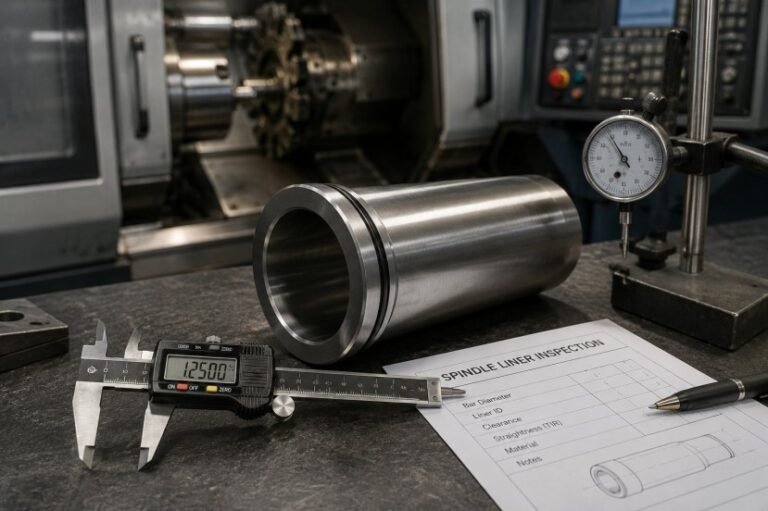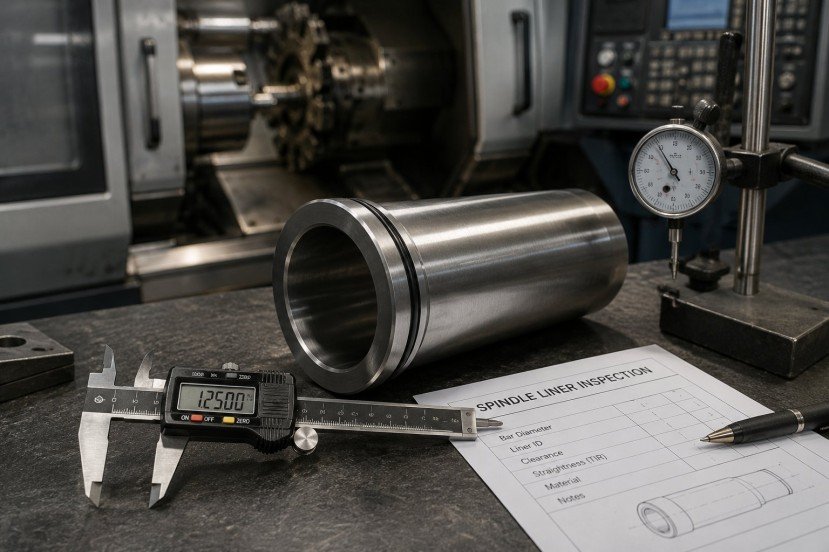
A high-quality spindle liner should support rotating bar stock with the correct clearance, maintain a straight internal diameter, remain rigid under operating conditions, and stay securely positioned inside the spindle or draw tube. These factors directly affect how effectively the liner controls unnecessary bar movement during CNC machining.
For manufacturers, spindle liner quality is more than a component-level concern. A poorly fitted, flexible, damaged, or incorrectly manufactured liner can introduce movement into an operation that depends on stability and repeatability.
Understanding how to evaluate spindle liner quality can therefore help machining operations make better purchasing decisions and identify potential problems before they affect production.
What Determines the Quality of a Spindle Liner?
Spindle liners reduce the inside diameter of a CNC lathe spindle or draw tube so that smaller-diameter bar stock receives additional support while rotating.
Three characteristics are especially important when evaluating how well a spindle liner performs:
- Correct clearance over the actual bar outside diameter
- Straightness of the spindle liner’s internal diameter
- Rigidity of the liner and its support system
Durability, mounting security, material selection, and machine compatibility also influence long-term performance.
The highest-quality liner is not simply the one made from a particular material. It is the liner engineered appropriately for the bar stock, machine, operating speed, and production environment.
1. Measure Bar-to-Liner Clearance
Clearance is one of the first variables manufacturers should evaluate.
The spindle liner’s internal diameter must provide enough room for the bar to rotate and feed properly while limiting unnecessary lateral movement.
When the liner is substantially larger than the actual outside diameter of the bar, the stock has more room to move inside the liner. That additional movement can contribute to bar whip, noise, and vibration.
This is why specifying a liner based only on a nominal bar size can be problematic. Actual bar outside diameter should be considered when appropriate.
Operations evaluating spindle liner quality should confirm:
- Actual bar outside diameter
- Spindle liner inside diameter
- Consistency of the bar dimensions
- Bar material
- Bar length
- Machine and spindle configuration
Correct clearance is application dependent, so the appropriate dimensions should be determined for the specific machine and material.
2. Check Spindle Liner Straightness
A spindle liner must remain straight enough to support the bar around the intended centerline.
If the liner itself moves away from center, the bar is no longer being supported consistently throughout the spindle. This can introduce another variable into an already dynamic rotating system.
Straightness should therefore be measurable whenever the liner construction allows it.
For example, JF Berns reports straightening its metal spindle liners to 0.005-inch total indicated runout (TIR). Because the finished liner is metal, that straightness can be physically checked and verified.
The important principle is not simply the numerical specification. Manufacturers should determine whether the liner supplier has a repeatable method for measuring and verifying liner straightness.
Questions worth asking include:
- How is liner straightness measured?
- Is straightness verified after manufacturing?
- Can internal and external alignment be checked?
- What inspection process is used before shipment?
A liner should not be assumed to be straight simply because it fits inside the spindle.
3. Evaluate Rigidity
Rigidity determines whether the liner continues supporting the bar when rotational forces act on the system.
A rigid liner helps maintain its position rather than flexing with bar movement. This becomes particularly important when a liner uses O-rings or other mounting points.
The presence of O-rings itself is not necessarily the issue. What matters is whether the liner remains adequately supported between those mounting points.
A flexible liner can potentially move away from center when forces from rotating stock act against it. Instead of controlling bar movement, the liner may deflect with the bar.
When evaluating quality, manufacturers should therefore consider the complete liner construction rather than examining mounting features independently.
4. Do Not Use Noise Alone as a Quality Test
A quieter spindle liner is not automatically a better-performing spindle liner.
Softer liner materials can dampen audible contact between the bar and liner. This can make an application sound quieter even when excessive clearance remains.
Conversely, excessive noise from a rigid liner may indicate that too much clearance exists between the bar and liner.
Effective bar control depends on several interacting variables, including:
- Bar-to-liner clearance
- Bar straightness
- Liner straightness
- Liner rigidity
- Bar diameter
- Bar length
- Spindle speed
- Machine configuration
Noise can provide useful diagnostic information, but operators should not use sound by itself to determine whether a spindle liner is performing correctly.
5. Inspect Material Condition and Durability
A spindle liner that begins with appropriate dimensions can still lose effectiveness if the material deteriorates.
Production environments expose liners to repeated bar loading, sharp edges, chips, coolant, heat, and mechanical contact. Material selection should therefore be evaluated in relation to actual operating conditions.
Steel spindle liners provide rigid construction and resist cutting from sharp bar edges. They also avoid the swelling, softening, and age-related changes that may affect some urethane liners.
According to JF Berns’ application experience, some urethane liners have swollen after exposure to operating conditions and become difficult to remove from the spindle. Heat can also contribute to softening in applicable circumstances.
Operators should periodically inspect liners for:
- Cuts or physical damage
- Deformation
- Swelling
- Excessive wear
- Material deterioration
- Embedded metal chips
- Changes that affect removal or installation
A liner should continue maintaining its intended dimensions and support characteristics throughout its usable service life.
6. Inspect the Liner for Embedded Chips
Surface-sensitive bar stock requires additional attention.
Softer materials may initially appear attractive for polished, chrome-plated, or ground stock. However, metal chips can become embedded in a soft liner surface.
Once embedded, the chip can become the actual contact point between the liner and bar, potentially scratching the material.
Steel is less likely to retain chips in this manner. Hardened steel liners can also be considered for applications where additional wear resistance or surface protection is needed.
Regardless of liner material, surface-sensitive operations should evaluate:
- Bar finish requirements
- Chip control
- Liner cleanliness
- Coolant conditions
- Maintenance procedures
- Bar condition
Regular inspection remains important even when a liner was correctly specified initially.
7. Verify Secure Mounting
A precisely manufactured liner provides limited value if it is not positioned securely in the machine.
Mounting should keep the liner aligned and properly supported while allowing installation and removal appropriate to the application.
The exact mounting arrangement depends on the machine.
Possible liner designs may include:
- Multi-piece configurations
- Extended liners
- Thin-wall liners
- Quick-change configurations
- Machine-specific mounting features
- Designs intended to simplify liner removal
Manufacturers should evaluate the entire support system rather than judging the liner as an isolated tube.
Why Does Spindle Liner Quality Matter So Much?
The spindle liner operates around bar stock that may be rotating at significant speed inside a CNC lathe. Small differences in support, clearance, alignment, and rigidity can therefore become increasingly important as operating conditions change.
Better Control of Bar Movement
The fundamental purpose of the liner is to support the bar.
Correct clearance and rigid support reduce the available space for unnecessary movement. Excessive clearance or liner deflection works against that objective.
More Stable Machining Conditions
Bar movement introduces another variable into the machining process.
Controlling the unsupported movement of the stock can help manufacturers create a more stable operating environment, particularly when bar length, diameter, and spindle speed make bar support more important.
Reduced Risk of Bar Whip
Bar whip occurs when rotating stock develops uncontrolled lateral movement.
The liner is one component of the overall system used to control that movement. Proper clearance, straightness, and rigidity are therefore important when evaluating bar-support conditions.
More Predictable Production
Manufacturing operations benefit from repeatable equipment conditions.
A liner that remains straight, rigid, properly mounted, and dimensionally stable provides a more predictable support system than one that changes shape or position during service.
Improved Equipment Decision-Making
Measuring spindle liner quality also helps purchasing teams avoid treating liners as interchangeable commodity components.
Two liners designed for the same nominal bar diameter may perform differently depending on their actual dimensions, straightness, construction, mounting system, and compatibility with the machine.
How Should Manufacturers Compare Spindle Liners?
A useful spindle liner comparison should examine measurable engineering characteristics instead of relying primarily on price or material descriptions.
| Quality Factor | What to Evaluate | Why It Matters |
|---|---|---|
| Bar clearance | Actual bar OD compared with liner ID | Controls the amount of available bar movement |
| Straightness | Measurable liner alignment or TIR | Helps maintain consistent support around the centerline |
| Rigidity | Resistance to deflection | Helps prevent the liner from moving with the bar |
| Durability | Resistance to wear, heat, chips, and coolant | Helps maintain performance over repeated use |
| Mounting | Security and alignment inside the spindle | Keeps the liner properly positioned |
| Surface condition | Damage, embedded chips, and wear | Important for both bar support and surface-sensitive materials |
| Machine fit | Compatibility with the actual lathe configuration | Prevents assumptions based only on nominal dimensions |
Quality should be evaluated as a complete system rather than a single specification.
What Information Is Needed to Specify a Quality Spindle Liner?
Manufacturers requesting a new or replacement spindle liner should be prepared to provide application-specific information.
Useful information can include:
- CNC lathe make and model
- Bar diameter
- Actual bar outside diameter when relevant
- Bar length
- Bar material
- Spindle or draw tube configuration
- Bar feeder or loader information
- Surface-finish requirements
- Current vibration or bar-whip concerns
- Available space
- Existing liner configuration
More detailed application information allows the liner manufacturer to evaluate the actual operating conditions instead of specifying a solution around assumptions.
Frequently Asked Questions About Spindle Liner Quality
What is the most important measurement for a spindle liner?
Bar-to-liner clearance is one of the most important measurements because excessive space allows additional bar movement. Straightness and rigidity are also essential because the liner must remain positioned around the intended centerline.
How can spindle liner straightness be measured?
Straightness can be evaluated using measurable runout or alignment inspection methods appropriate to the liner construction. Manufacturers should ask the supplier how straightness is verified during production.
Does a quieter spindle liner mean it is better?
No. Softer materials can reduce audible contact while still allowing excessive bar movement. Noise should be considered alongside clearance, straightness, rigidity, spindle speed, and the overall machine configuration.
Can a spindle liner wear out?
Yes. Liners can experience wear, physical damage, contamination, or material deterioration depending on their construction and operating environment. Periodic inspection is important.
Are metal spindle liners always better than urethane liners?
The correct material depends on the application. However, rigid metal construction provides measurable straightness, dimensional stability, and resistance to several forms of production-related deterioration. The machine, bar stock, and operating environment should still determine the final selection.
What should be checked when troubleshooting spindle liner performance?
Start by examining bar-to-liner clearance, liner straightness, rigidity, mounting, bar condition, liner wear, spindle speed, and the complete machine configuration. Vibration or noise should not automatically be attributed to one component.
Spindle Liner Quality Should Be Measured, Not Assumed
The quality of a spindle liner ultimately comes down to how effectively it supports the bar under real operating conditions.
Correct clearance, measurable straightness, rigidity, secure mounting, and long-term dimensional stability provide practical criteria for evaluating that performance. Manufacturers that measure these variables can make more informed decisions than operations selecting liners primarily by nominal size, material, or price.
JF Berns manufactures machine-specific spindle liners and has experience with steel and hybrid urethane configurations. Operations evaluating an existing liner or specifying a new one can submit their machine make and model, bar dimensions, material, and application requirements for review.
For CNC operations, that application-specific evaluation is important. The spindle liner may be a relatively simple component, but its ability to control rotating bar stock can influence the stability of the entire bar-machining process.
About the Author