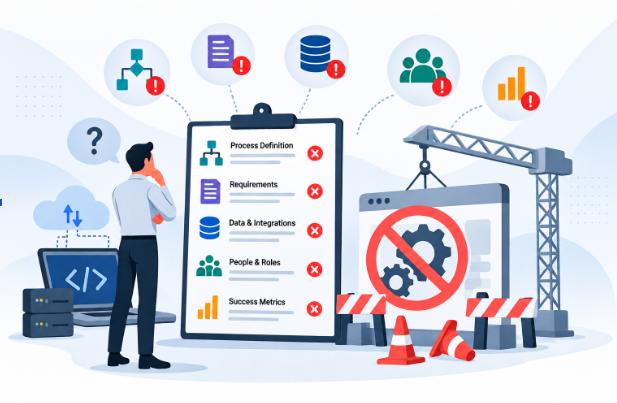
Business automation is often treated as a technology challenge: choose a platform, connect a few systems, build the workflows, and launch. In practice, many automation initiatives encounter problems long before development begins. The underlying process may be unclear, requirements may be based on assumptions, or teams may try to automate steps that should have been redesigned first.
These issues become even more important as businesses connect multiple applications, databases, and operational workflows through n8n workflow automation. When the foundation is weak, even technically sound automation can produce limited results. Understanding what needs to be fixed, standardized, measured, and validated before selecting a technology can significantly reduce implementation risks and create a clearer path to sustainable automation.
The Process Was Never Clearly Defined
Automation cannot fix a process that the business itself does not fully understand. Before development begins, teams need to map how a task actually moves from one step to another, including inputs, approvals, handoffs, exceptions, and final outcomes. Without this clarity, developers may automate an incomplete or inaccurate version of the workflow.
This becomes especially challenging when different departments follow different procedures for the same task. What appears to be a simple workflow on paper may involve manual decisions, duplicate data entry, or undocumented workarounds in practice. A proper process analysis helps identify unnecessary steps and establish a standardized workflow before automation is introduced.
The goal is not to automate every existing step. It is to first determine which steps create value, which create friction, and which can be eliminated entirely. Only then can the business define an automation workflow that reflects how the process should actually operate.
Companies Automate Broken Processes
One of the most common automation mistakes is speeding up a process that was already inefficient. If a workflow contains unnecessary approvals, duplicate data entry, excessive handoffs, or repetitive manual checks, automating every step simply makes the same problems happen faster.
Before automating a process, businesses should examine why each step exists and whether it still serves a purpose. Some activities may be eliminated, while others can be simplified or standardized. This process improvement stage is important because automation works best when the underlying workflow is already clear and consistent.
A useful approach is to separate process improvement from process automation. First, remove unnecessary complexity and define the desired workflow. Then determine which remaining activities can be automated reliably. This prevents businesses from investing in technology that reproduces inefficient processes instead of solving them.
The Business Problem Isn’t Clearly Defined
“ We need automation” is not a business objective. Before development begins, teams need to identify the specific problem they are trying to solve and how success will be measured.
For one company, the goal may be to reduce order-processing time. For another, it could be eliminating repetitive data entry, reducing errors, speeding up approvals, or giving managers better visibility into operations. Each objective can lead to a different automation approach.
A clear problem statement also prevents scope from expanding unnecessarily. Instead of attempting to automate an entire department at once, businesses can focus on a defined bottleneck with measurable outcomes. Establishing the current process, identifying where time or resources are being lost, and defining the desired result gives the development team a practical foundation to work from.
Automation should begin with a measurable business problem not with a technology that happens to be available.
Requirements Are Based on Assumptions
Even when a business understands its process, automation can fail if the requirements are incomplete. Teams may document the ideal workflow while overlooking exceptions, approval rules, user roles, data dependencies, or situations that occur only occasionally but are critical to operations.
Requirements should therefore be gathered from the people who actually perform and manage the process. Developers need to understand what triggers the workflow, what information it needs, what decisions can occur at each stage, and what should happen when something goes wrong.
It is also important to distinguish business requirements from technical assumptions. A request such as “automatically approve these orders” raises further questions:
- Which orders qualify?
- Who can override the rule?
- What happens when required information is missing?
- Where should the approval be recorded?
Answering these questions before development reduces rework and helps ensure the final automation reflects the real business process rather than an assumed version of it. For workflows that require functionality beyond existing platforms, clearly defined requirements also provide the foundation for custom software development that aligns with the business’s actual processes and operational needs.
Existing Data and Systems Are Overlooked
An automation workflow rarely operates in isolation. It usually depends on data from existing systems such as an ERP, CRM, accounting platform, inventory system, or internal database. If these systems contain incomplete, duplicated, or inconsistent data, automation can reproduce those problems at scale.
Integration constraints can create another challenge. A business may have clearly defined processes, but its existing applications may use different data structures, authentication methods, or integration capabilities. Legacy systems may also lack suitable APIs, making reliable data exchange more difficult.
This is why businesses should assess their data quality and system landscape before development begins. Identifying where information comes from, how it moves between systems, and which integrations are required helps uncover technical constraints early. It also prevents teams from designing an automation workflow that looks effective on paper but cannot reliably operate within the existing technology environment.
ROI and Success Metrics Are Missing
Automation projects become difficult to evaluate when businesses cannot clearly define what success looks like. Simply completing an automated workflow does not necessarily mean the project has delivered business value.
Before development begins, teams should establish measurable targets based on the problem they identified. Useful KPIs can include order-processing time, approval turnaround time, manual hours saved per month, data-entry error rate, workflow completion rate, number of manual handoffs, processing cost per transaction, and percentage of tasks completed automatically.
For example, if processing an order currently takes 20 minutes, the business could set a target of reducing it to 8 minutes. If employees spend 100 hours each month on repetitive data entry, a measurable objective could be to reduce that workload by 60%. Establishing these baselines makes it easier to compare performance before and after automation.
ROI should also be considered beyond direct cost savings. Faster response times, better data accuracy, improved visibility, and increased employee capacity can all contribute to the value of an automation project.
Without clear metrics, businesses may struggle to determine whether the automation solved the original problem or simply introduced another technology layer.
Employees and Process Owners Are Left Out
When the people who actually run a process are excluded from automation planning, critical exceptions can remain invisible until the system goes live. The result can be an automation workflow that works technically but disrupts day-to-day operations, creates new manual work, or forces employees to find workarounds.
Automation changes how people perform their daily work, yet employees and process owners are often brought into the project too late. The people closest to a workflow can identify issues that may not appear in process documentation, such as unusual approval cases, customer-specific requirements, or information that must be checked in another system before an action can proceed.
Involving process owners during discovery and validation helps businesses distinguish between the documented process and how work actually happens. It also gives teams an opportunity to test proposed changes before development is complete.
Successful automation should therefore be designed with the people who understand the process, not simply for them. Their input can reduce implementation surprises and improve adoption once the automated workflow goes live.
Technology is Chosen Too Early
Choosing a technology before understanding the business problem can lock an automation project into the wrong approach. Teams may select a platform because it is popular, familiar, or capable of impressive features, only to discover later that it does not fit their workflows, integrations, data requirements, or scalability needs.
Technology selection should come after the business has defined the process, requirements, data sources, integrations, and expected outcomes. At that stage, dedicated development teams can evaluate whether an existing automation platform, custom application, API-based integration, or another approach is appropriate.
The decision should also account for factors such as system compatibility, security, maintenance, scalability, and the technical skills required to support the solution. For example, a workflow that mainly involves connecting existing business applications may require a very different approach from one that needs a custom application or complex backend logic.
The goal is not to find the most powerful technology. It is to find the technology that best fits the validated business process and its long-term requirements.
How to Validate an Automation Project Before Development
Before investing in development, businesses can validate an automation project through a structured discovery process. The first step is to document the current workflow, identify the specific bottlenecks, and define the outcome the automation is expected to improve.
Next, teams should review the requirements with process owners and identify exceptions, dependencies, data sources, and integration requirements. This helps confirm that the proposed workflow reflects how the business actually operates rather than how it is assumed to operate.
A small proof of concept or limited pilot can then be used to test the most critical part of the workflow. Instead of automating an entire department at once, businesses can validate one defined process, measure its performance, and identify issues before expanding the solution.
Finally, the project should have clear success criteria, including measurable KPIs, expected operational improvements, and technical requirements. This validation approach helps businesses determine whether the process is ready for automation and provides developers with a clearer foundation for implementation.
Conclusion
Business automation projects rarely fail because the technology cannot perform the required task. More often, problems begin with unclear processes, incomplete requirements, overlooked system dependencies, unrealistic expectations, or poorly defined goals.
Validating the business problem, standardizing the workflow, involving process owners, assessing existing systems, and defining measurable outcomes before development can significantly reduce these risks. It also gives teams a clearer basis for choosing the right technology solutions for their specific requirements.
Automation should therefore be treated as a business improvement initiative supported by technology not simply as a development project. When the foundation is well defined before implementation begins, businesses can build automation that is more reliable, measurable, and sustainable.
About the Author