Modernizing eCommerce Architecture
Modern eCommerce enterprises operate in a high-stakes ecosystem. Beyond basic online storefront maintenance, managing digital retail involves maintaining complex data pipelines, orchestrating real-time inventory across global warehouses, providing instant customer support, and delivering hyper-personalized shopping experiences.
As digital storefronts scale, legacy monolithic architectures and surface-level integrations often create significant friction. Merchandising teams waste hundreds of hours manually tagging inventory, customer service units become overwhelmed with repetitive post-purchase inquiries, and static search engines fail to convert natural-language user queries.
To overcome these structural hurdles, forward-thinking brands are turning away from basic off-the-shelf plugins in favor of specialized, enterprise-grade architecture. By leveraging specialized ai development services alongside core platform customizations, businesses can modernize their digital infrastructure to drive measurable efficiency, lower customer acquisition costs, and build long-term operational resilience.
Key Operational Challenges in Modern Digital Retail
While acquiring new customers remains a top priority, internal operational inefficiencies often quietly undermine profitability. Growing eCommerce organizations routinely face several structural challenges across their technical workflows:
- Inflexible Product Discovery: Traditional keyword-based search mechanisms struggle with user intent, typos, and conversational search terms. When shoppers cannot find relevant items within seconds, bounce rates surge.
- Manual Catalog Management: Managing extensive product catalogs across multiple regional storefronts demands substantial manual oversight. Extracting attributes, structuring metadata, and optimizing SEO titles by hand consumes valuable administrative bandwidth.
- Customer Support Bottlenecks: Standard pre-scripted chatbots frequently fail to address complex transactional requests, such as real-time order modifications or nuanced product comparisons, leading to high support ticket volumes.
- Data Silos and Performance Drag: Integrating third-party machine learning models into large-scale platforms like Adobe Commerce (Magento) or Shopify often leads to high latency, API rate-limiting issues, or database lockups if the architectural foundation is weak.
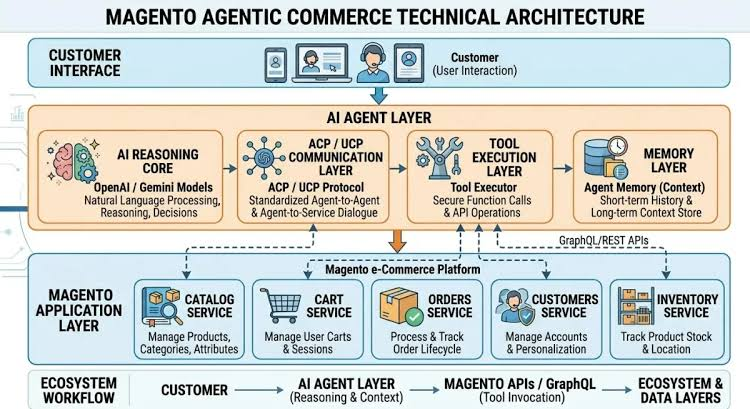
[ Customer Interface: Web / Mobile App ]
│
▼
[ API & Orchestration Gateway ]
│
┌────────────────┴────────────────┐
▼ ▼
[ Native Commerce Core ] [ Custom AI Microservices ]
• Inventory & Checkout • Semantic Vector Search
• Customer Account Data • Automated Catalog Enriched
• Order Management System • Dynamic Recommendation Engine
Architectural Best Practices for AI and Platform Integration
Implementing intelligent features into an eCommerce environment requires a structured engineering approach. Quick fixes or unoptimized scripts can slow down page load times—a outcome that directly hurts conversion rates. Adopting industry best practices ensures performance remains uncompromised as new capabilities are deployed.
1. Decoupled AI Microservices
Rather than executing resource-intensive natural language processing (NLP) or predictive analytics directly within the core eCommerce application server, enterprises benefit from an asynchronous, decoupled microservices model. By offloading heavy computing tasks to scalable cloud endpoints connected via REST or GraphQL APIs, the primary application tier remains lightweight, stable, and responsive.
2. Semantic Search and Vector Database Infrastructure
Replacing standard SQL-based text searches with vector-based semantic search engines enables platforms to interpret customer intent rather than relying solely on exact keyword matches. Mapping product catalogs into vector embeddings allows search systems to process nuanced search queries—such as “breathable summer running wear for trail environments”—and surface accurate product matches instantly.
3. Automated Catalog Enrichment Workflows
By using vision and language models, merchants can automate catalog enrichment. Automated pipelines can analyze raw supplier images and unstructured technical sheets to generate optimized product titles, structured attribute tags, meta descriptions, and localized content across multiple languages, cutting operational setup time significantly.
Key Core Applications Driving eCommerce ROIChoosing the Right Execution Partner
Implementing advanced technologies across enterprise platforms like Adobe Commerce (Magento) or Shopify requires specialized domain knowledge. Off-the-shelf software rarely
| Core Capability | Traditional Approach | AI-Enhanced Solution | Business Impact |
| On-Site Search | Keyword matching via database query | Semantic vector search with context awareness | Reduced bounce rate, higher search-to-cart conversion |
| Catalog Enrichment | Manual copy writing and tag entry | Automated metadata, vision tag extraction, and SEO generation | Faster time-to-market for new collections |
| Recommendations | Rule-based category matching | Multi-dimensional behavioral modeling | Higher Average Order Value (AOV) and cross-sells |
| Customer Support | Rule-based decision trees | Conversational agents connected to real-time order APIs | Lower ticket resolution costs and 24/7 coverage |
aligns seamlessly with complex B2B or multi-store B2C workflows out of the box. Custom business logic, specialized ERP integrations, and unique checkout routines demand tailored development.
Working with an established enterprise partner ensures that technical solutions directly address specific operational bottlenecks without creating technical debt. As a trusted magento ecommerce agency, Amasty offers a comprehensive portfolio of custom development, performance tuning, and advanced platform extensions. With years of experience supporting global brands, Amasty builds reliable, scalable, and high-performing digital environments tailored to long-term business goals.
Step-by-Step Implementation Strategy
Migrating from a legacy setup to an intelligent, scalable eCommerce architecture requires clear execution steps:
| Phase | Strategic Focus | Technical Deliverables |
| 1. Audit & Discovery | Identify platform bottlenecks and target high-impact business workflows | Infrastructure performance audit, data structure mapping, and ROI projections |
| 2. Architecture Design | Plan API interfaces, vector databases, and asynchronous data pipelines | Technical integration specs, security protocols, and failover workflows |
| 3. Prototype & Test | Deploy targeted microservices in a staged environment | Sandbox deployment, vector search validation, and load testing |
| 4. Deployment & Scaling | Launch production integrations with real-time monitoring | CI/CD pipeline release, performance caching, and staff training |
Frequently Asked Questions
How do custom AI services integrate with existing eCommerce platforms like Magento or Shopify?
Integration typically relies on a decoupled, microservices-based architecture. Instead of processing heavy computations directly within your primary application server, custom AI models run on scalable cloud infrastructure and communicate with your storefront via REST or GraphQL APIs. This ensures high performance, minimal latency, and no risk of database lockups during peak traffic.
Will implementing automated catalog enrichment or search features slow down site load speeds?
No—when executed properly using asynchronous processing and modern caching strategies, site speed remains fast. Advanced search engines use dedicated vector databases optimized for instant sub-second retrieval, while heavy catalog workflows (such as batch image tagging or automated metadata generation) execute in the background via scheduled queue workers.
What is the typical timeframe and ROI for an enterprise eCommerce AI development project?
Initial discovery, architecture design, and staging prototypes usually take between 4 to 8 weeks, with full production deployment following iterative load testing. Most merchants see immediate ROI through higher search-to-cart conversions, reduced bounce rates, increased Average Order Value (AOV) via smart recommendations, and significantly lower administrative hours spent on manual merchandising tasks.
Why choose tailored custom development over off-the-shelf SaaS plugins?
While SaaS plugins offer quick setup, they frequently introduce rigid feature limits, security vulnerabilities, monthly subscription scaling costs, and performance drag on core storefronts. Custom development gives enterprise merchants full ownership of their data pipelines, seamless compatibility with custom ERP/CRM business logic, and custom-built features tailored specifically to their unique operational workflows.
How do I determine whether my store is ready for modern AI microservices?
Your store is ready if you face measurable operational bottlenecks—such as managing large, complex product catalogs across multiple regions, handling high volumes of repetitive customer support requests, or struggling with low search conversion rates on a legacy keyword search. An initial technical audit by an expert development team can help pinpoint high-value integration areas.
Building a Scalable Digital Future
As digital commerce continues to evolve, market leadership belongs to businesses that systematically remove operational friction and optimize the customer journey. Transitioning from legacy, manual processes to intelligent, automated workflows is no longer just an advantage—it is essential for long-term scalability.
By combining proven platform development methodologies with modern microservices, brands can boost team productivity, deliver exceptional shopping experiences, and unlock sustainable revenue growth.
About the Author